






 | |||||||||||||||||||||||||

1. Electro
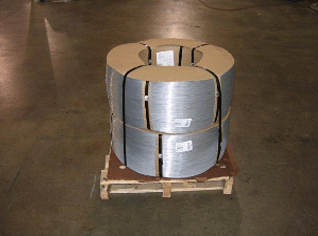
Galvanized Steel Wire
Electro
Galvanized Iron Wire is also known as electric
galvanized iron wire or galvanized steel wire.
Electroplating is the process of producing a metallic
coating on a surface by the action of an electric current.
Also, various substances(addition agents) are added to the
electroplating bath to obtain a smooth and bright metal
deposit.
Application:
 |
| * Perform a
mainly protective function to prevent corrosion
|
Production Process:
Wire Rod-Pickling-Drawing-(Annealing)-Pickling-Boiling-Drying-Zinc Plating-Wire Coiling.
We produce usually goes through standard processes under careful control from steel rod coil, wire drawing, annealing, rust removing, acid washing, boiling, drying, zinc plating to wire coiling.
Products Available
Wire
Diameter of Electro Galvanized Iron Wire:
0.14mm-5.0mm(Guage #38 thru #6).
Zinc
amount: From about 8 Gr/M2 to 120
Gr/M2
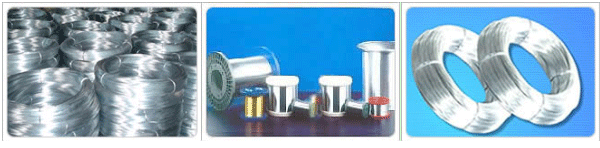
Packing: Coils, Bobbins,
Spools, U-type wires or straightened and
cut
Usage: Wire mesh, nails,
fencing, tie wire, etc.
Galvanized Steel Wire
2. Hot Dip Galvanized Steel Wire
As the name
"Hot Dip" implies, the wire that is to
be galvanized is past through a molten zink
bath.
During this process, the zinc is
metallurgically bonded to the steel forming a progression
of
zinc-iron alloy
layers.
Surface Preparation
* Caustic cleaning-to remove organic matter such as dirt, paint, oil and grease.
* Acid
pickling-to remove scale and rust
fluxing
-to
prevent oxides from forming prior to galvanizing.
Hot Dip Galvanizing
The material
is thoroughly dried after surface preparation and then
totally immersed in a bath of
molten zinc
at 840 Deg C. During this process, the zinc is
metallurgically bonded to the steel
forming
a progression of zinc-iron alloy
layers. Upon removal from the bath the material is
drained, vibrated
or centrifuged to remove
excess zinc.
Quenching
The
galvanized steel is then dipped in a dilute chromate
solution to give a longer lasting luster
and
to reduce temperature for prompt
handling and inspection.
Inspection
The process
is completed by a careful inspection of the zinc coating
for thickness, adherence,
uniformity and
appearance.
Aluminum
coated Wire: Hot dip aluminum is
preferred for use in industrial environments,
especially
where there are high
concentrations of sulfur dioxide and other pollutants.
Application:
For Steel pilings above and below the mud and water lines,
in marine
atmospheres,
Offshore
oil platforms, Ship chain lockers, Fish holding tanks, etc.
Zinc
coated Wire: Zinc provides
greater galvanic protection than aluminum. Its greater
galvanic
power protects gaps in the
coating better than pure aluminum. It is marginally easier
to spray pure
zinc than pure aluminum by
some flame or arc spray systems.
Applications:
Steel bridges, Inside of potable water tanks, Power
transmission and
Communication
towers,
Buried iron pipe, Cathodic protection of re-bar set in
concrete.
There are
two types of systems which use the sprayed zinc; one
relies on an impressed electrical
current,
and the other is passive or galvanic.
Zinc
Aluminum coated Wire: Zinc-15%
aluminum wire combines the benefits of pure
zinc with the
benefits of pure
aluminum in the metalized coating. It is very
often used as a substitute for pure
zinc
because it is somewhat more
chloride and sulfur dioxide resistant than pure zinc,
while retaining the
greater
electro-chemical activity of pure zinc.
3.
International Standards of Zinc Coating Weight:
See
Reference the attached
chart
International standards |
For |
ASTM A641/A641M-98 Class A |
Standard specification for zinc-coated (galvanized) carbon steel wire |
BS 443: 1982 |
Testing zinc coatings on steel wire and for quality requirements |
JIS G3547-1993 AS 1650-1989 |
Zinc coated low carbon steel wires Hot dip galvanized coating on ferrous articles |
AS 2423 |
Australian standard for galvanized wire fencing products |

